Post-election I looked at several very large, long-standing nonprofits that had mission’s that aligned with my desire to get involved as a volunteer. I was shocked at the lack of capacity and infrastructure many of the national organizations that I wanted to get involved with had. Specifically, their inability to capture the groundswell of support, help and donations being offered.
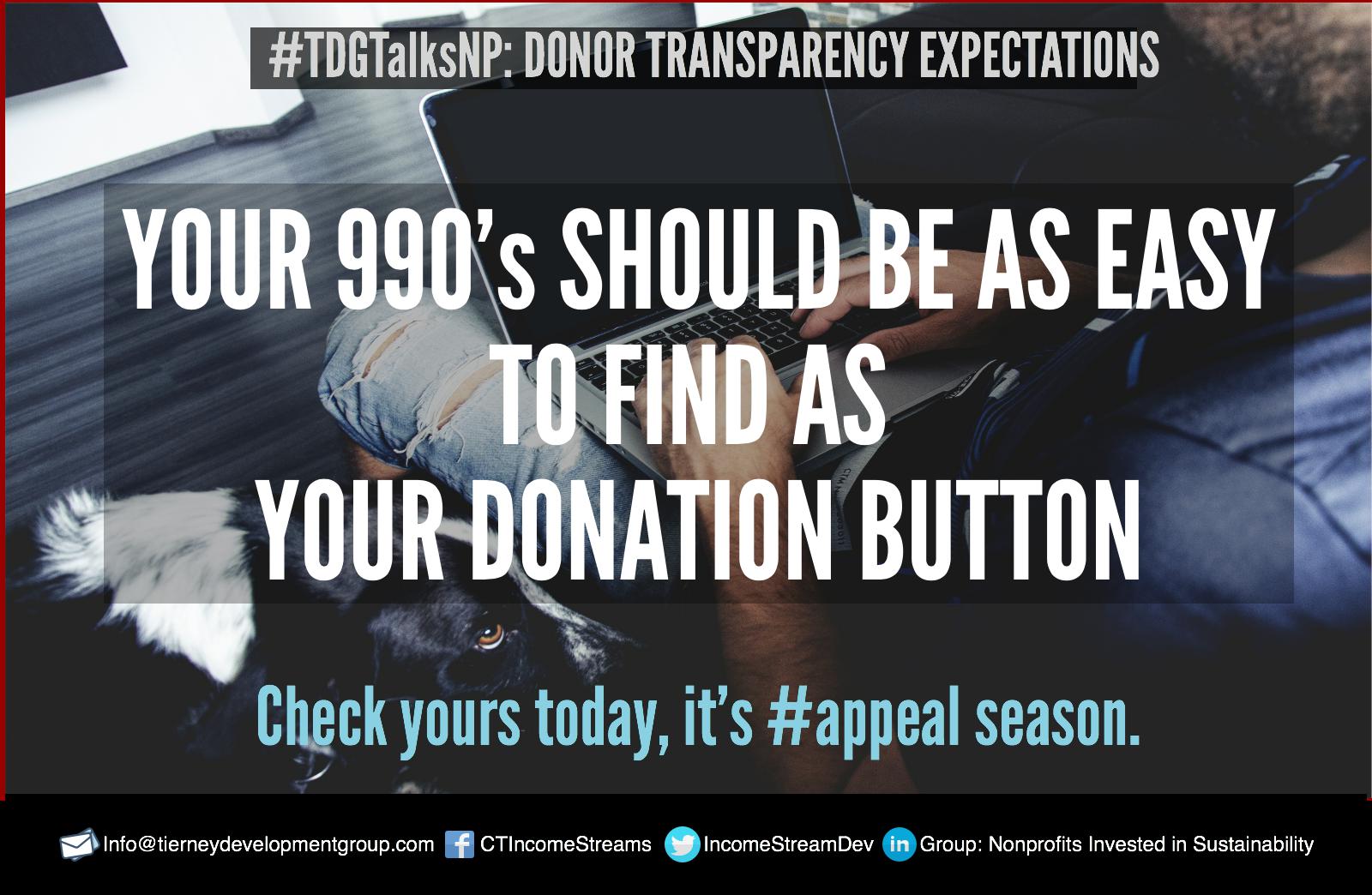
I researched each; looking at their 990’s, websites, bylaws, etc.. The results were disheartening. Many had no financials posted, nor 990’s available through my development channels and no development strategy in place.
As a potential donor and volunteer, I had no way of finding out what their financial needs are, how they manage their money and how I can best help.
There is a high expectation of access to information, transparency, and ease in accessing both an organization’s volunteer and financial needs for donor and visitors.
Are your 990’s as easy to find as your donation button?
If not, you need to ask yourself: Are you speaking to your audience and their needs or highlighting information that doesn’t create and, in fact, maybe is stopping engagement?
One organization I’m passionate about helping has 20 immediate grants, emergency grants, available to them. I’ve been unable to contact them, through any channel; email, phone, Twitter, LinkedIn.
These lost opportunities for nonprofit’s lead to a general distrust in potential donors, funders anyone looking to help a well-established organization that’s mission speaks to them.
This issue was our Twitter theme all week and a large part of the Nonprofit Sustainability talk I conducted last week at the Fairfield Public Library, and that will be shown on TCTV through 2017.
Please see our 30Tips in 30Days Twitter Series or email us for help. There are many easy, low costs solutions we can help your organization with immediately. Appeal season is at hand; there's no time to waste; 40% of your unrestricted income will be coming through your, or another organization’s doors over the next six weeks…let’s ensure it goes to your organization.

Sustainability Questions Are Offensive
Do you agree?
I recently read an article that mentioned how offensive the sustainability question was to potential grantees on grant applications. The author gave examples of different ways grant writers could respond to funders that ask about their efforts to create sustainable funding.
The premise was:
• Funders have a job; that job is to give money to non-profits.
• Funding is difficult to obtain, never mind sustain.
• Applicants need funds and writing grants takes a lot of time.
The sustainability question is a distraction and waste of time.
• The economy will turn around and funding will be back to old levels; this funding request will help bridge the grantee until that time.
In other words; your job is to fund, and my job is to ask for funding.
WHAT IF SUSTAINABILITY IS AN ACHIEVABLE CONCEPT
Look at funding through a funders eyes; funding is an investment. Funders have a mission and guidelines for fund disbursement, just as non-profits allocate funds to support and execute their mission.
Imagine a scenario where a non-profit serves the homeless community with a specific goal to help the homeless obtain housing first and a job second. Would it be reasonable for an out of work mortgage broker to utilize the non-profit's employment program because they need a job? Or, would their use of the program divert funds from the non-profits target population; mission work?
Well-matched partnerships that fund shared priority areas and initiatives build strong long-term relationships that serve each and the communities both serve.
SUSTAINABILITY IS REAL, EXPECTED AND NECESSARY
Sustainability is possible; you must diversify your income opportunities and put consistent effort into developing each.
Donors and funders expect transparency, strong business practices, and income diversification. Sustainable funding expectations are not a trend that will go away.
Most organizations just need some direction on how to succeed within the new funding landscape.
Begin by asking a few questions, does your organization:
• Onboard properly?
• Make contacts specific and targeted for the recipient NOT the organization?
• Cultivate interest and relationships?
• Thank those who support your organization?
Focus your efforts year-round on these issues to create sustainability.
Consultants are a cost effective tool to utilize while an organization reassesses and adjusts its strategy. Contact us today; we work off of a menu to create sustainable funding for your organization. We believe in coaching current employees to execute these efforts.

Ethics in Business: The Chicken or the Egg?
I’m always leery of those who say either for sure. In business it’s irrelevant. No chicken: no egg:: no egg: no chicken.
This question will arise, most often, when credit is taken or given to a group within an organization and not to the entire funnel. Discussion becomes centered around and stuck on:
· Which is more important the idea or the task execution?
o With no idea, there is no task, with no task completion the idea dies.
· Which is more important the idea, lead, cultivation or execution?
o Without each there is no result, no result, equals no product or service and no product or service leads to no revenue.
§ Without revenue, there is no business. No business means no jobs. No jobs…
OPPORTUNITY
These questions provide an opportunity to examine and address cracks in your organization’s structure, most often centered around teamwork.
A business with employees signifies a need, by the owner, at some point, to break up functions that were of such value that each should be funded to handle and feed the funnel from inception to fruition for the good of the organization’s ability to grow its bottom line.
Credit does need to be given or taken for the seeds planted and their cultivated at each step of the executing model. Project management and logic models provide accountability for each task and step in a process. Missing steps will lead to a different outcome than the one planned in the model and is easy to identify. The question becomes are you willing to train-up to teamwork or accept hits to your bottom line and staff discontent?
ORGANIZATIONAL ISSUE: TEAMWORK
How do you determine if teamwork is an issue in your organization and if training-up will help your bottom line? Ask yourself these questions:
· Does the organization have one task function area that takes, or is given, all the credit for projects or outcomes?
· Does leadership think the end dollar amount (sale/revenue/donations) is the only metric that counts?
· Do staff members sabotage their tasks (give less than 100%) due to these, or other undefined, factors?
· Do staff and leadership understand what teamwork is and that teamwork leads to job security?
· Do you have staff silos within your organization?
· Do you know how to address these silos, break them and rebuild a strong organization?
These are important questions for small businesses and non-profits to ask and address head-on.
TEAMWORK IS MORE THAN TRUST BUILDING, BUT TRUST IS NECESSARY
Teamwork is the reason each employee was hired. The business owner or Board determined that each function was needed and created a plan to hire staff, to work together, to deliver product or service as efficiently as possible to increase the bottom line. Increasing the bottom line is the only vehicle for bonuses and raises. Teamwork is the juggernaut of a business and non-profit. Silos and the unwillingness to break them is no longer a sustainable business nor non-profit model. Nor can it be hidden, the bottom line is the best indicator of silo issues in businesses and non-profits.
SOLUTION
Conduct a blind survey through a vehicle like Survey Monkey with your staff. Ensure staff that the results are confidential and encourage 100% participation.
After the survey share and discuss the results and ask your staff for solutions, this provides staff an opportunity to articulate their concerns, be heard and affect the outcome of new performance measures that will benefit each essential function of your organizing and increase your production in a positive manner.
If you feel the discussion is best guided, bring in a consultant. A consultant will provide a format and mitigate opportunities for the discussion to get off track or personal.
Addressing these very real issues today will create a much happier work environment for staff and a positive financial result for the organization.

Non-Profit Development: Hire an Employee or Hire a Consultant?
Executive Directors can no longer be expected to run the management, operations and development responsibilities of a small to medium size non-profit. Non-profit funders and donors need to recognize the inefficiency and disservice to the non-profit in doing so. Make a commitment to fund development and operational support costs. I cover the operational piece in other blog posts, today we'll discuss development.
Funding development work frees-up Executive Directors to make valuable connections and partnerships in the community, run the organization, manage staff, and programs more effectively. A commitment to development illustrates to staff, program managers, donors and funders that funding their positions and the non-profits long-term viability are a priority worthy of financial support.
The idea of adopting small business practices is often an uncomfortable reality for non-profit staff and management. Today's funding climate requires non-profits to think more like a small business:
Creating more predictable and diverse income, i.e. stability.
Staying up-to-date on social media platforms, rapidly changing messaging and donor expectations to cultivate financial relationships and partnerships.
Grant funders require non-profits to demonstrate the steps they are taking to diversity, requiring accountable outcome measures for these plans.
How do you fund development work? The real question is: how do you not?
The options are: to train an internal candidate; continue to require the executive director to do this work; hire a development professional, or; hire a development consultant.
If your non-profit hasn’t consistently funded marketing and development work since the economic downturn, I recommend hiring a consultant. If you have funded both and need a full-time, in-office development professional to work 40 hours a week in the office, hire a development professional. If you are unsure, hire a consultant.
Determine Which Fits Your Organization Best
A good consultant offers you real time best practices, flexibility, benefit cost and overhead savings. As you increase income and realize savings funnel those resources into outreach efforts to further your development work and deliver on your mission.
Hiring a seasoned development professional that hasn’t consistently funded development work in the last several years is a risky proposition. Is this person up-to-date on the rapidly changing development and marketing landscape? Are they aware of and comfortable working on the wide variety of platforms and touch-points that each donor segment prefers? Are they willing to stay up-to-date with the rapid rate of change on and of each?
How to Identify a Consultant?
Hire a consultant from your local catchment area with a passion for the organization's mission with a business or non-profit development background. The personal connection to the organization's mission and the catchment community is invaluable to the work that will be done. A one-stop shop consultant is ideal and the most cost effective option (graphics, branding and messaging). Development, marketing and messaging need to be seamless and responsive.
Make the Most of Your Development Commitment
Funding development allows Executive Directors to focus on creating sustainable business practices. These efforts support not only the new development work but the programs, services, and staff behind fulfilling the non-profit mission.
Your Board may be uncomfortable fundraising, most are, yet they may be willing to, at least in part, put their funding efforts behind the essential development position that their Executive Directors and the organization needs.
Community Foundations have a vested interest in helping non-profits take this essential step. They are poised to be leaders in creating the structure and support non-profits need to become truly sustainable.
These discussions need to occur within a framework and with the goal of progress and long-term financial sustainability. It is a commitment necessary to remain viable in today’s non-profit marketplace.

A Big Ugly Word in the Non-Profit World: Sustainability
Originally posted on LinkedIn on May 2, 2016
Non-profits and funders are stuck in a funding trap due to differing realities and measures of organizational sustainability and what is needed to get to that coveted place.
Who starts this conversation? What are the consequences of not having the discussion on sustainability? I believe funders and Boards need to give Executive Directors a safe opportunity to discuss these issues and support them in solving this essential component holding most, if not all, non-profits back.
Funding back office operations and development work are essential to a non-profits ability to deliver programs and services central to its mission. Yet, funding these areas is taboo. Without investment in these areas, how do you create efficiencies which will translate to more stable funding? You can’t. This quagmire forces non-profits into a perpetual cycle of inefficiency—the VERY thing that watchdogs and the media hold-out as the reason to hold back donations to non-profits.
Sustainability requires stability and efficiencies. Smart investments in infrastructure and development are the most efficient and cost-effective delivery system to achieve this goal. We know this in business and our personal lives, why is it different for non-profit entities?
Small to medium size non-profits are struggling. The paradigm needs to shift; the conversation needs to begin.
Start the conversation.
Today starts our 20 Tips in 20 Days for Non-Profits on Twitter and Facebook.

Sick of Wasting Time Networking?
Monday May 1st at 7pm: Sick of wasting time networking? Then don't miss Monday nights vibrant Q&A on networking and how to create the win:win you need to be effective and build your business! Thank you to the Fairfield Public Library & Fairfield Chamber of Commerce for bring this talk to Fairfield! Must pre-register through the FPL, click image above for more information.

Non-Profit Sustainability
Non-Profit Sustainability, Originally Published on LinkedIn on Feb 9, 2016
Share on LinkedIn
Share on Facebook
Share on Twitter
Non-profits, foundations, donors and government agencies, are in a battle of over what defines sustainability. Foundations, donors, and government agencies require non-profit grant applicants to state in their proposals how the project or initiative they are seeking funding for is sustainable. At the same time, non-profit applicants are given a list of cost restrictions that, if included, would preclude them from funding.
Upon funding, grantor-reporting requirements often include funding updates, initiative progress reports and could include metrics and feedback. What is left out of the pre-funding proposals are the true back office operational funds necessary to execute the funded initiative and reporting. These costs could include: computers, upgrading obsolete or unsupported software, internal computer networks and maintenance, support staff to promote/brand/market the initiative, program registration support, preparation of program materials, etc.. Each item or task just listed has associated costs and, with stable funding, provide operational efficiencies. Non-profits use back-office workers and equipment for multiple initiatives to deliver quality programming, grant reporting, and mission work. Not being able to properly fund these functions trap non-profits in a cycle of inefficiency. Vital functions, to any organization, cannot be funded in fits-and-starts if true sustainability is the goal.
Sustainability implies stability and efficiency. If the goal is sustainability, then investment in these areas is critical for the funder and the community that the grant was funded to serve.
Please visit www.tierneydevelopmentgroup.com for the full text of our Position Paper: Non-Profit Funding Quagmire: Sustainability. The barrier to sustainability. What is true sustainability and how to get it? January 2016, Kristen Tierney.
(c) 2016 All rights reserved. Kristen Tierney, The Tierney Development Group.

ANNUAL APPEALS: It's That Time of Year Again
Published on LinkedIn on Dec 1, 2015: Updated November 25, 2016.
Last year a SVP I know mentioned how annoying and unnecessary annual appeals were for nonprofits; that nonprofits this time of year were vultures out for a money grab; that nonprofits in our state are, in fact, flush with money. Her annoyance and belief in these ‘facts’ were absolute. Any appeal that got to her door was sure to be remembered, and not for the positive impact the organization has made in their community.
This interaction was a perfect example of the challenge our state nonprofits face: many people are willing to donate their time but not their money. Or, attend a gala, company paid, but wouldn’t even consider giving the same $175 to the nonprofit to fund their programming. We all think someone else is giving: the rich ones, the big businesses, the foundations. When, in fact, it's those with the least means that stretch the furthest to give and are often the biggest and most consistent donors. Every dollar matters to both parties, therefore, it's valued when given and received.
Connecticut nonprofits struggle quite a bit in our state. We are a diverse state with pockets of vast wealth and pockets of deep poverty. In the middle, residents are deeply taxed and care for their neighbors and loved ones with the ‘discretionary’ income that used to be sent along annually to nonprofits.
What can you do? Research the nonprofits you are interested in: Ask where their funding goes? Where it comes from? Has their income risen or fallen over the last five years? And, what funding trends are they seeing?
An organization that seems off balance on staff compensation does not mean they are not serving their mission or wasting funds. In fact, their mission may be 100% dependent on the roles of staff. A better question is: How many jobs are your staff members doing now compared to five years ago? Is funding the main issue behind each employee doing more work? Have you had to lay off staff?
Then ask how you can help spread the word of the work they do. In today’s world, money is important and necessary- but so is reach. Through our networks, we can change lives without ever knowing via a simple click; offering a lifeline, a link to help, hope or support that someone in your network didn’t know was available. Each time you make that connection you are not only making a difference in someone’s life you are helping a nonprofit fulfill their mission, which make no mistake about it, they have a passion for doing!
So, you don’t have to give money, but know their needs are real. They need funding to serve their mission and community. Know the value of your network, the hope you can offer and the connections you can make. Consider making a small donation to a cause that speaks to you. Annual appeals are vital to nonprofits, supporting the ones you care about ensures their ability to continue serving your community.
This #GivingTuesday I hope that you'll reach out to organizations working in your community and either share their work with your network or make a small donation to them.
Kristen Tierney is a Small Business & Non-Profit Development Consultant in Fairfield, Connecticut.